

Sources & Bibliography
This narrative is grounded in published historical research and regional folklore documenting the life of Josie Morris Bassett and the social history of Brown’s Park and Uintah County.
McClure, Grace.
The Bassett Women. Athens: Ohio University Press, 1985.
Burton, Doris Karren.
Dinosaurs and Moonshine: Tales of Josie Morris Bassett and Jensen’s Other Unique History and Folklore. Vernal, Utah: Vincent Brothers, 1990.
Redford, Robert.
The Outlaw Trail. New York: Grosset & Dunlap, 1976.
Museum of Northwest Colorado
Regional historical interpretation and archival context related to Brown’s Park, frontier ranching, and outlaw-era folklore.
https://www.museumnorthwestco.org/
BRown’s Park, Colorado
Josie Bassett was not an outlaw in the way history usually defines one. She did not run, did not hide, and did not vanish into legend. Instead, she stayed put, year after year, decade after decade, living so openly and fully that her life became impossible to simplify.
She stands out as one of the most colorful figures in Brown’s Park and Uintah County history not because she sought attention, but because she refused to live quietly when survival, dignity, and generosity required something more. Josie was, at once, a white-haired grandmotherly figure and a woman who rustled cattle, poached deer, and brewed bootleg whiskey when circumstances demanded it. She lived for more than fifty years alone in a cabin without plumbing, electricity, or a telephone, deep within what is now Dinosaur National Monument, content among her flowers, gardens, orchards, cattle, and animals. Her life unfolded not as spectacle, but as persistence.
The Bassett family arrived in Brown’s Park in the 1870s, unconventional even by frontier standards. From her mother and from ranch life, Josie learned to ride, rope, shoot, and raise cattle. From her father, she learned generosity, manners, and an unshakable sense of hospitality. Cowboys and outlaws passed regularly through Brown’s Park, and Josie grew up among them, absorbing the social rhythms of a place where law and custom rarely aligned neatly.
She was educated at St. Mary’s of the Wasatch in Salt Lake City, a refinement that sharpened her confidence rather than softening her resolve. Over time, her personal life became a source of constant rumor. She married five times, divorcing four husbands—scandalous in an era when women were expected to endure—and was widowed once. That husband’s death, likely caused by acute alcoholism, sparked whispers that followed her for years. Josie was never free from speculation, but she did not allow it to shape her choices.
In 1913, when land near Vernal opened for homesteading, Josie left Brown’s Park and struck out on her own, nearly forty years old, determined to build something lasting. She found her land on Cub Creek, ten miles and two canyons north of Jensen. A few years later, she ran off her current husband with a frying pan. By then, she had realized that her true commitment was not to marriage, but to the land itself.
Josie built a new cabin in 1924. While clearing brush for gardens, she grew frustrated with the long skirts expected of women, which tangled in thorns and slowed her work. She switched to pants—bib overalls for labor, tailored trousers for town. Skirts were reserved for weddings and funerals. When her long, curly red hair caught in brush one day, she cut herself free with an axe and finished the job with scissors. From then on, she wore her hair short. Josie did not make statements; she made decisions.
She lived largely self-sufficient. She gardened, ran cattle, canned food, made jerky, soap, and clothing. Her goal was never bare subsistence, however. She was generous to a fault, especially toward her son, Crawford McKnight, and his family, who lived with her for a time. During the Great Depression, Josie effectively ran her own relief operation, feeding neighbors in need and even giving up her cabin one winter to house a homeless family while she lived in a dugout.
When money ran short, Josie found ways to make it.
During Prohibition, needing cash to support her grandchildren, she began brewing bootleg whiskey. She did not drink herself and saw nothing immoral in the work. A brother-in-law secured her a copper still, which she hid in a brush-filled gulch. When the whiskey was properly distilled and aged, she transported it in wooden kegs down the canyon, delivering it to distributors and a few trusted customers. Her apricot brandy became particularly well known. She continued bootlegging even after Prohibition ended, stopping only when warned that federal revenue agents were on their way and when her son threatened to destroy the still to avoid prison and disgrace.
Josie’s search for income eventually brought her into direct conflict with the law again. During the Depression, cattle rustling—once quietly tolerated—became less forgivable. In 1936, an old enemy accused Josie of butchering cattle and selling the meat in town. Six ranchers joined the accusation. Hides were found buried on her property, and she was arrested. Neighbors posted bail.
Josie denied the charges, claiming she had been framed, but the county attorney believed the evidence pointed to her guilt. In court, Josie presented herself exactly as she was: polite, gracious, impeccably mannered, a sixty-two-year-old grandmother in a dress. Her defense attorney was the local LDS stake president. The jury failed to reach a verdict. At her retrial, the jury hung again. The county attorney eventually gave up.
Even then, Josie stayed.
In 1945, hoping to return to cattle ranching for profit, she attempted to secure her land legally after years of squatting. Unable to obtain a bank loan, she signed the property over to another party to secure financing. Through misunderstanding or betrayal, she lost the land, retaining only her cabin and a few surrounding acres. There she lived for nearly twenty more years, sustained at last by a pension rather than cattle or whiskey.
In 1963, at the age of eighty-nine, Josie fell in her cabin and broke her hip. Alone, she lay in agony until discovered. The injury ended her life on the homestead. Disheartened and displaced, she died a few months later, remembered with deep affection by the people of Jensen and Vernal.
Josie Bassett did not become a legend by disappearing.
She became one by staying, working, feeding others, breaking rules when necessary, and refusing to apologize for surviving on her own terms.
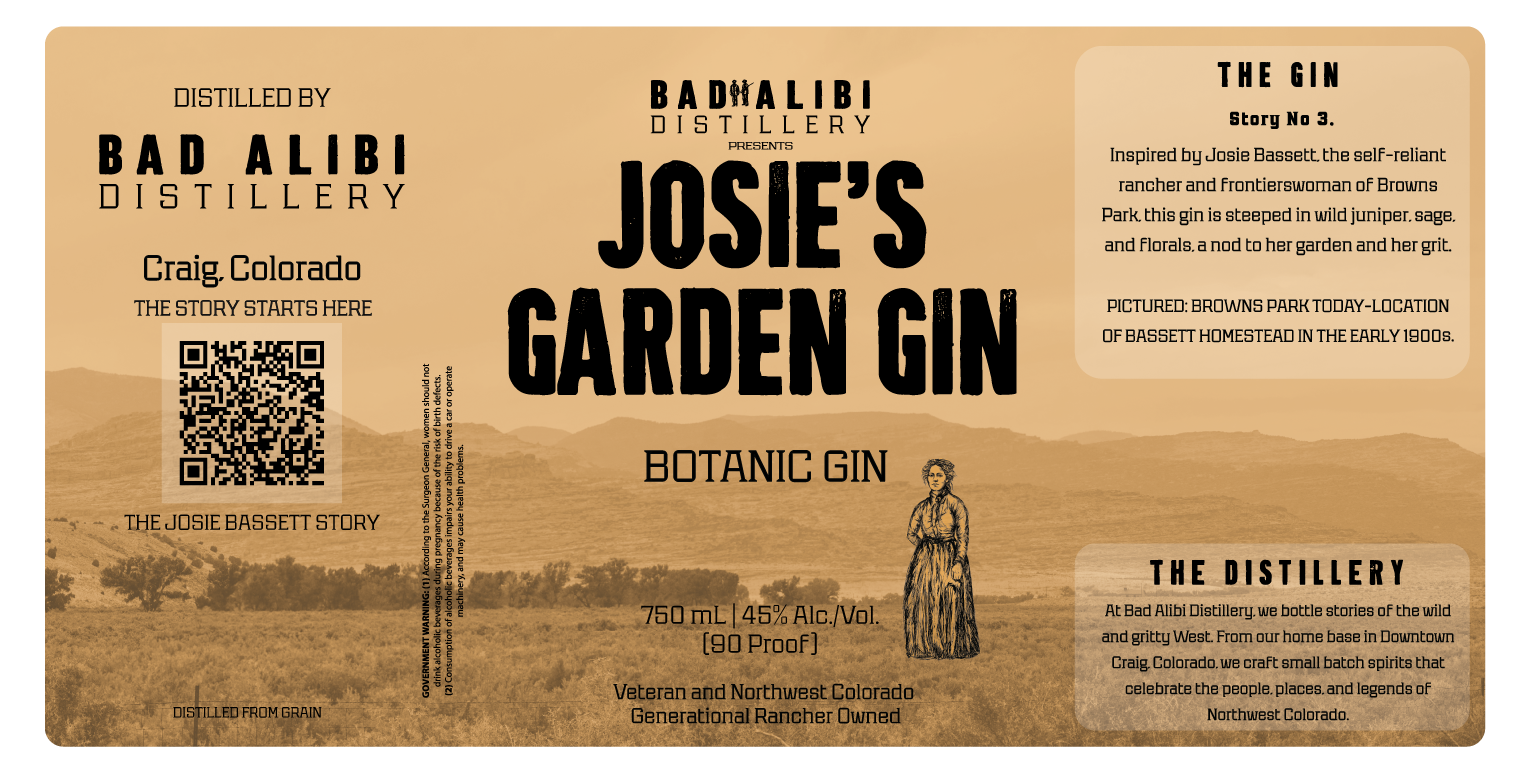
Josie’s Garden Gin is made in that spirit—rooted, generous, layered, and quietly defiant. Not sharp for the sake of it. Not ornamental. Built from patience, cultivation, and the understanding that real strength doesn’t need permission.